


Is It Time to Ask for a Refund for My Implant Overdenture?
In January 2026, I had a consultation with a dentist about replacing my overdenture, which fits on four mini-implants. I explained that I would be out of state in late April for an extended work assignment and wanted to be sure the denture could be completed before then. The dentist told me it would take about three weeks.
When the denture was delivered in late February, it didn’t seem to line up properly with the implants. The dentist had difficulty getting it into place and had to force it down. After I got home, I tried to eat soft food, but chewing was difficult.
I was able to remove the denture, though it was very hard to take out. When I tried to put it back in, it would not go onto the implants. I contacted the office the next day, and another dentist examined it because my dentist was not available. He told me the denture needed adjustment because the holes around the attachments were not drilled correctly. I’ve also noticed that one side of the denture sits lower than the other, and the teeth lean slightly backward.
The office recently told me the dentist plans to order new gaskets for the attachments and believes that it will correct the issue. At this point, however, I’m not satisfied with how the denture fits, and I don’t have much time left before I leave. I would like to know whether it would be reasonable to request a refund, as I cannot stay for a remake.- Thanks. Lemuel from NV
Lemuel,
When you agreed to proceed with treatment, the dentist told you the overdenture could be completed in about three weeks. That estimate helped you plan your treatment before leaving the state.
Instead, the denture arrived later than expected. When it finally arrived, it did not seat correctly on the implants. Because the treatment was delayed and the denture did not function properly, requesting a refund is reasonable.
Factors That Encourage a Fair Resolution
Dentists typically value their professional reputation and want patients to feel satisfied with their care. When a problem occurs, patients often have several ways to encourage a fair resolution.
These factors can influence how a situation is handled:
- Patient reviews online. Many people check reviews before choosing a dentist.
- Dental board oversight. A complaint may prompt the board to review the treatment.
- Insurance review processes. Insurance companies may investigate concerns about treatment they helped pay for.
Most patients use these options simply as leverage to encourage cooperation, not to create unnecessary conflict.
The Clinical Concerns
An overdenture supported by implants should sit smoothly and securely over the attachment components. Patients should be able to remove and replace it without unusual difficulty.
The issues you described raise several questions about the denture’s construction and fit.
For example:
- The denture required force to fit on the implants
- The attachment openings were not prepared correctly
- The denture appears uneven when in place
Because these problems affect the denture’s basic fit, replacing small attachment parts, such as gaskets, may not fully resolve the issue.
Mini Implant Cases Require Specific Skills
Implant overdentures require technical precision, and dentists often gain these skills through additional training after dental school. Mini implants are less commonly used than standard implants, so experience with them can vary among dentists.
It would be reasonable to ask about the dentist’s experience with mini-implant overdentures, especially if the current denture does not fit well.
How to Ask a Dentist for a Refund
Begin the conversation politely. Let the dentist know that the denture has not worked for you and that your move makes it difficult to continue adjustments or remakes.
Explain that a refund would allow you to seek treatment elsewhere once you relocate. If you appreciated other aspects of the office, mentioning those positive experiences can help keep the discussion constructive.
If the dentist is not willing to work with you, you still have other options, including contacting the dental board or your insurance provider. In many cases, simply discussing the problem openly leads to a reasonable solution.
Hartford, Connecticut, dentist, Dr. Thaddeus Michalski, sponsors this post. Read why many of his patients say he is one of the best dentists in town.
See a Dentist or Oral Surgeon for Dentures and Implants?
Should I see a dentist or oral surgeon for immediate dentures and implants? I lost most of my teeth to gum disease and agreed with my dentist that extractions are best for the few remaining teeth. My dentist showed me 10 to 12 pictures of her patients’ dentures, but I don’t like how they look. I will switch dentists, but I wonder if I should see a dentist or oral surgeon first. My mouth is in such bad shape that I want to get this done as soon as possible, so the thought of immediate dentures makes sense. I would like to have this behind me by early fall. Thanks. Curtis
Curtis,
Should You See a Dentist or Oral Surgeon for Implant Dentures?
If you want implant dentures, we recommend searching for a dentist with advanced implant training who can remove your remaining teeth, place dental implants, and restore the implants with a custom denture. Teeth-in-a-Day and All-on-4 dental implants are fixed implant overdentures. You can get all the treatment you need in one location from one provider, eliminating miscommunication between an oral surgeon and restoring dentist who provides the denture.
However, completing your smile and preserving your oral health will take time. Avoid looking for a dentist who promises to meet your timeline rather than doing what’s best for your oral health and quality of life.
What Is an Immediate Denture?
An immediate denture is a removable denture for an entire arch of missing teeth. A dentist places the denture on the same day as tooth extractions. Still, before agreeing to any treatment, we recommend consulting with a periodontist (gum disease specialist) or a dentist with periodontal training to ensure your gums are healthy. However, you mentioned that you also want dental implants. So, the process will be different.
How Long Does It Take to Get Implant Dentures?
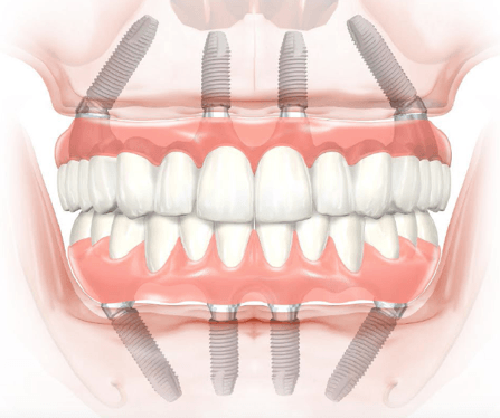
Getting implant dentures takes six months to a year, even longer if you need gum disease treatment first. If you qualify for dental implants, you may be interested in Teeth-in-a-Day or All-on-4 dental implants. You can get dental implants and temporary dentures in one visit. Your dentist will provide a custom final denture after your implant heal.
However, before you get implant dentures, a dentist will examine your mouth and take X-rays and a 3D CT scan to determine the following:
- Your gum health and whether you need periodontal treatment
- Your jawbone quality and volume
- Whether you need bone grafting before dentures and implants
The treatment you get from an implant dentist depends on your medal and dental history and the status of your oral health.
Schedule a consultation with a dentist with advanced implant training to get high-quality implant overdentures, including All-on-4 dental implants. The dentist will explain your treatment options for dentures and dental implants.
Dr. Thaddeus Michalski, a Rocky Hill, Connecticut dentist and Diplomate of the International Congress of Oral Implantologist, sponsors this post. He serves Hartford, Connecticut, and surrounding communities.